ATM Code · Self-service software

Turn every self-service device into a digital branch

Multivendor software for ATMs, ADMs and kiosks, with server modules for transactions, monitoring and content. One build for any vendor and OS, integrated with processing once.
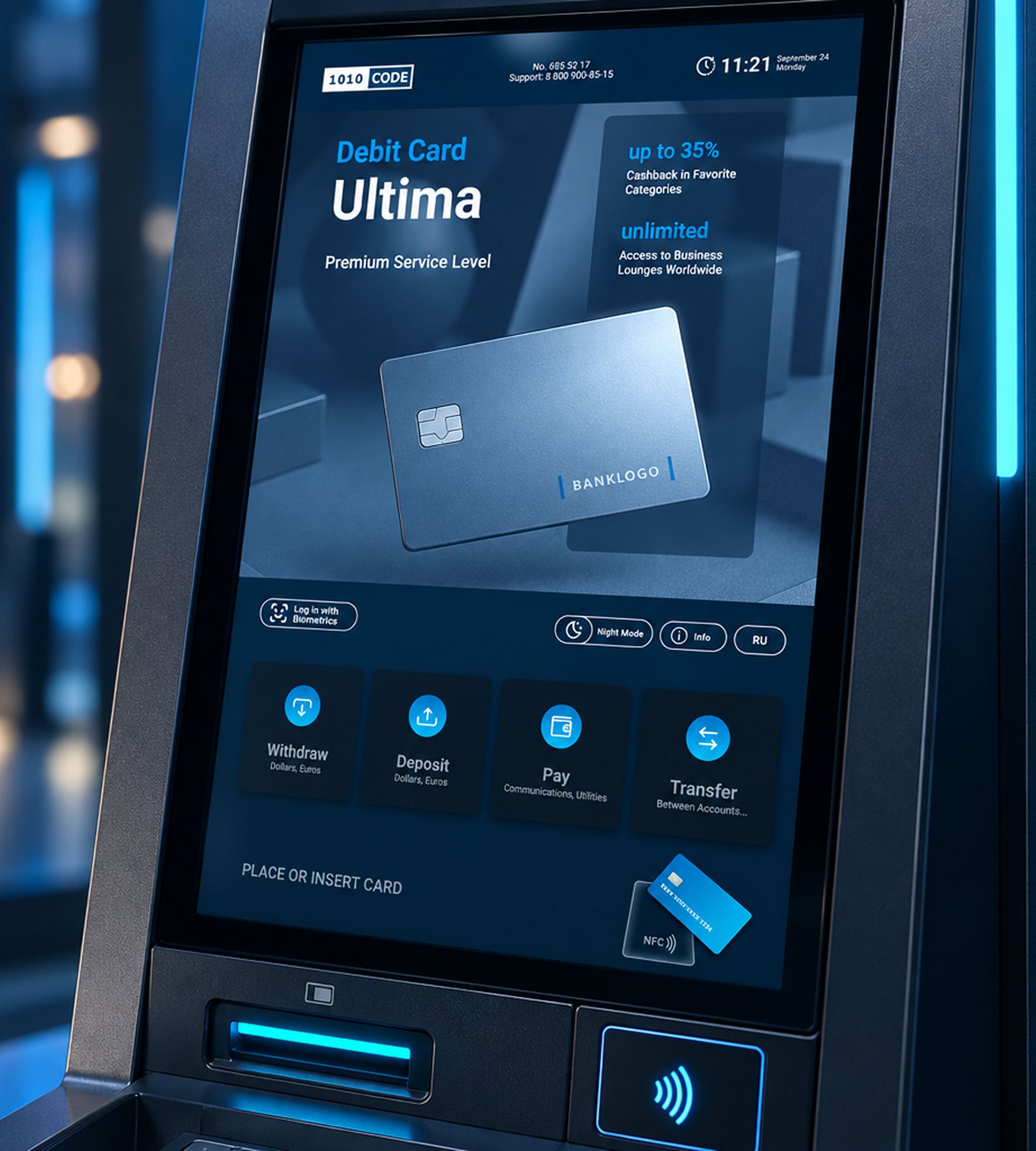
ATM touchscreen with the ATM Code home screen: a card offer and buttons for withdrawal, deposit, payments and transfers
ATM Code installations on ATMs and ADMs
20,000+
ATM Code clients in 15 countries
50+
devices in the largest ATM Code network
6,000

01What it is

Software on the device. Services on the server.

ATM Code is a complete package: control software for self-service devices and the server components that integrate them with the bank and deliver business functions. No additional software is needed except XFS.

On the device

ATMs, ADMs, kiosks and cash-in terminals

  • One software version for every vendor, model and OS
  • Works through XFS or direct drivers
  • Responsive web UI for any screen, touch or FDK, dual-screen setups
  • Interface adapts to the device: touchscreen, cash-in, NFC reader
  • Peripherals: cameras, contactless readers, sensors, UPS, lighting

On the server

Modular — each component updates independently

  • Operation Server — transactional core: scenarios, payments, fees, routing
  • Monitoring Server — status, remote control, updates, inventory
  • DBP Server — personal account services with smart caching
  • Advertising module — content and personal offers
  • Card Gateway, Processing Gateway, Crypto Service — card data and HSM

02When it makes sense

Six situations where banks choose ATM Code

  • 01

    A mixed fleet

    Legacy and new devices from different vendors, running different operating systems.

  • 02

    Branch transformation

    Branch functions need to move to ATMs and kiosks.

  • 03

    A digital office

    The network has to do more than cash-in and cash-out.

  • 04

    Cost of the network

    Usage needs to grow while servicing costs go down.

  • 05

    An outdated interface

    The current UI is old or problematic and needs a modern replacement.

  • 06

    Several languages

    The interface must work in two, three or more languages.

03Value for the bank

What each team gets

A full branch menu on every device — out of the box

Standard and advanced customer scenarios ship with the solution, so the business launches services instead of commissioning development.
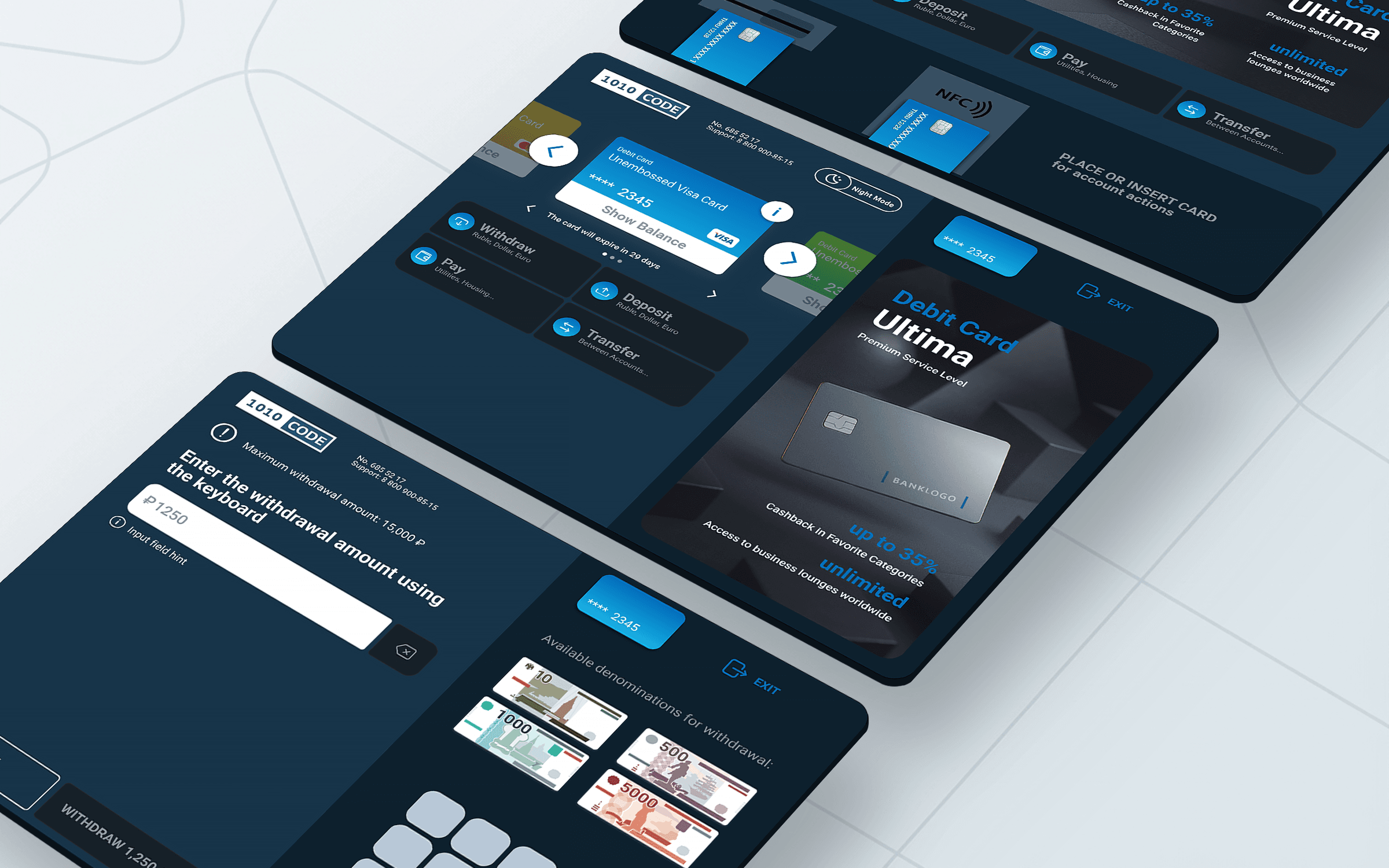
  • Cash withdrawal: Fast Cash, denomination choice, withdrawal by QR code
  • Cash deposit to card, including by QR code
  • Payments by card or cash — with change — to an unlimited number of providers
  • Card-to-card transfers and e-mail receipts
  • Personal account: products, history, loan applications and early repayment
  • Payment templates shared with remote banking
  • Omnichannel scenarios: start a payment or withdrawal in mobile banking, finish it at the ATM
ATM Code interface screens: main menu, card offer and cash withdrawal with banknote denominations

One integration, one build, one place to change things

ATM Code removes the ATM controller and NDC scripting from the processing side and keeps the device software identical across the fleet.

  • Host-to-host integration with processing — no NDC/DDC
  • ATM controller and device monitoring are part of ATM Code
  • PIN pad key management in 1010Code with HSM integration
  • One software build for Windows, Linux and RED OS
  • Modular server: update components independently
  • Customer products pulled from remote banking, not the card switch

20,000+

ATM Code installations on ATMs and ADMs

See and control every device from one console

Monitoring Server ships with ATM Code and needs no extra integration. It works reliably even over low-bandwidth connections.

  • Real-time device and peripheral status with unified XFS error codes
  • Remote tasks: lock and unlock, config changes, logs, screenshots, restarts
  • Background software updates applied when the device is idle
  • Automatic inventory of hardware, firmware and software versions
  • Cash cassette counters, replenishment history and denomination control
  • Roles, Active Directory and a full audit trail
  • Can pass data to the bank’s own monitoring server if it stays in place

Fewer replenishment trips, fewer errors at the cassette

Recycling and guided replenishment reduce the cost of servicing the network.

  • Cash recycling support
  • Guided end-to-end replenishment with hints for collectors
  • Cassette parameters checked against the host before loading
  • Offline replenishment mode; no host balancing during replenishment
  • Replenishment records by currency, denomination and collector

6+ months

of ATM operation without cash replenishment, thanks to recycling

Turn the ATM screen into a sales channel

The built-in advertising module lets marketers run campaigns and personal offers without IT. Customer Journey Analytics shows what happens on the screen — inside the bank’s own infrastructure.

  • Banners, click-through scenarios, forms and personal offers
  • Offers driven by preloaded data or the bank’s CRM in real time
  • Targeting by location, device type, service, payment amount and time, and customer demographics
  • Moderation before display; deployment on premises or in Microsoft Azure
  • Impressions, clicks, conversions and funnels per campaign
  • Journey analytics: paths, funnels, session recording, A/B tests, cohorts

≤10 min

to launch an ad campaign across the ATM network

04How it works

Architecture built for a network, not a single device

Devices talk only to the ATM Code server over an encrypted protocol. The server handles business logic and integrates with the bank once, on behalf of the whole fleet.

On the device

  • ATMs, ADMs and recyclers
  • Kiosks and cash-in terminals
  • Control software via XFS or direct drivers
  • Web UI in embedded Chromium (CEF)
  • Cameras, NFC readers, sensors, UPS

ATM Code server

1010Code V3 protocol over HTTPS · the device always initiates the connection

Operation Server

  • Scenarios
  • Payments and transfers
  • Fees and limits
  • Routing

Monitoring Server

  • Real-time status
  • Remote tasks
  • Software updates
  • Inventory

Customer services

  • DBP Server
  • Advertising and offers
  • Journey analytics

Card data

  • Processing Gateway
  • Card Gateway
  • Crypto Service

Bank systems

  • Processing centerHost-to-host, no NDC/DDC
  • HSMThales payShield 9000 / 10000
  • Core and remote banking
  • Payment providers or bank gateway
  • Anti-fraud, Active Directory, CRM
  • Device-initiated, encrypted

    All requests between devices and server are signed and encrypted; the device always opens the connection.

  • Proven stack

    Windows or Linux; PostgreSQL, MariaDB or MS SQL; Docker deployment for Monitoring Server.

  • Scales with the fleet

    Clustering with horizontal and vertical scaling; metrics exported in Prometheus format.

05Integration with processing

Integrate once — and stop rewriting NDC

ATM Code connects to the processing center over a host-to-host protocol. The integration is done at the start of the project and does not change afterwards.

  • 01

    No ATM controller on the bank side

    Controller and monitoring functions are part of ATM Code.

  • 02

    Key management included

    PIN pad keys are managed in 1010 Code Software from day one.

  • 03

    Maximum security

    Every message is signed with PIN keys.

  • 04

    No NDC work

    Implementation needs no NDC-related modifications.

  • 05

    No per-ATM processing licenses

    No license fees to the processing center for each ATM or for NDC functions.

  • 06

    Adaptable protocol

    The host-to-host protocol can be adapted to the bank’s business requirements.

06Security

Certified where it matters

PCI SSF covers the whole solution — including server components, the development process, source code storage and delivery to customers.

  • All components, including server

    Includes two standards

    PCI SSS
    Secure Software Standard — security of the software itself
    PCI SLC
    Secure SLC Standard — secure development lifecycle
  • Certified EMV kernel
  • Signed and encrypted traffic

    Requests between devices and server are signed and encrypted.

  • Sensitive data masked

    Card data is masked and encrypted between Card Gateway, processing and device.

  • HSM-backed keys

    Key generation and storage via Thales payShield 9000 / 10000, with a full key history.

  • Controlled access

    Role-based access with Active Directory and an exportable audit trail.

07Implementation

A predictable path to production

Typical work on an ATM Code project. Several steps are skipped when the hardware or processing vendor is already supported.

  1. 1. Hardware support

    Add support for device models not yet covered.

    Skipped for supported models

  2. 2. ISO image

    Prepare the system image for the bank’s devices.

  3. 3. Processing integration

    Connect to the processing center over host-to-host.

    Skipped if the vendor is already integrated

  4. 4. HSM integration

    Thales payShield 9000/10000 ready; other vendors on request.

  5. 5. Branding and languages

    Standard UI in the bank’s colours; RU and EN included.

  6. 6. Launch

    Test and production environments, testing with international payment systems.

08Technical capabilities

For the architects in the room

01Supported devices and operating systems
  • ATMs, ADMs, kiosks, e-cashiers and teller machines
  • Vendors in production include Wincor Nixdorf, NCR, OKI, Hyosung and Dors
  • Windows, Linux and RED OS — one build
  • XFS layer or direct drivers; vendor utilities can be launched from service mode
02User interface and SDK
  • UI is a web application in embedded CEF Chromium: HTML5, ES6, React, TypeScript
  • Standard UI customised through CSS, or a fully custom single-page app over the JavaScript API
  • UI SDK, device emulators and in-browser debugging without restarting the ATM software
  • UX prototype in Axure and screen designs in Figma
03Monitoring Server
  • C# on Windows Server; MS SQL 2012+ or PostgreSQL; Docker supported
  • Proprietary traffic-efficient TCP protocol, connection initiated by the device
  • Task templates, batch queues and a scheduler; dynamic device filters
  • Optional REST API for external systems; metrics in Prometheus format
04Operation Server
  • Windows or Linux; PostgreSQL, MariaDB or MS SQL
  • Access Manager with Active Directory, built-in anti-fraud, BCIT for postings
  • Payment gateways and a customizable chain of transaction handlers
  • Service availability by payment instrument, geolocation and other parameters
05Video surveillance and peripherals
  • Unlimited USB cameras; recording on motion or customer operation
  • Captions with date, masked card number, operation type and key events
  • VIVOpay Kiosk III/IV and OTI contactless readers
  • Temperature, tilt, door sensors; UPS monitoring; lighting control

09Implementations

Running in networks of thousands of devices

Most of our clients are under NDA. Figures come from live deployments.

  1. 01

    Bank · Central & Eastern Europe

    One of the region’s largest banks, 420+ branches

    • ATM Code
    Challenge
    Run a fleet from four vendors — Wincor Nixdorf, NCR, OKI and Dors — on one software and take ATMs beyond cash.
    Solution
    ATM Code across the entire network: personal account, payments, loan repayment, personal offers and contactless NFC / *Pay on every device.

    Result

    devices on one software version
    5,000+
    hardware vendors under one monitoring
    4
  2. 02

    Bank · Europe

    One of Europe’s largest banks, 7M+ clients

    • Payments Code
    • ATM Code
    Challenge
    Centralize payment acceptance across branches, self-service devices and remote banking.
    Solution
    Payments Code as the central hub for cash desks, kiosks, ATMs, internet and mobile banking, plus recurring payments. ATM Code with a personal account on self-service devices.

    Result

    providers in the payment hub
    8,000
    branch cash desks
    3,200
    ATMs and kiosks
    4,000 + 1,800
  3. 03

    Bank · Eastern Europe

    Bank with 497 offices in 224 cities and a 38,000-device partner network

    • Payments Code
    • ATM Code
    Challenge
    Unify payment acceptance across cash desks, terminals, ATMs and auto-payments, and connect instant payments.
    Solution
    Payments Code for all acceptance channels, ATM Code to extend ATM functionality, payment acceptance at teller desks, integration with the instant payments system.

    Result

    service providers
    10,000+
    ATMs
    4,400
    cash desks
    800
  • 700+ devices

    Including 250 Hyosung 8600 units and 8 “light offices” built on ATM Code.

  • 6,000+ devices

    Multivendor network, still scaling to new ATMs.

  • 1,500+ devices

    Different vendors and screen formats up to 32”.

Let’s look at your ATM network

For banks

Discuss ATM Code for your fleet

Share your fleet size, vendors and goals — we’ll outline the project scope.

Discuss a solution

For partners

Add ATM Code to your portfolio

Offer ATM Code to banks in your market and earn on delivery.

Become a partner